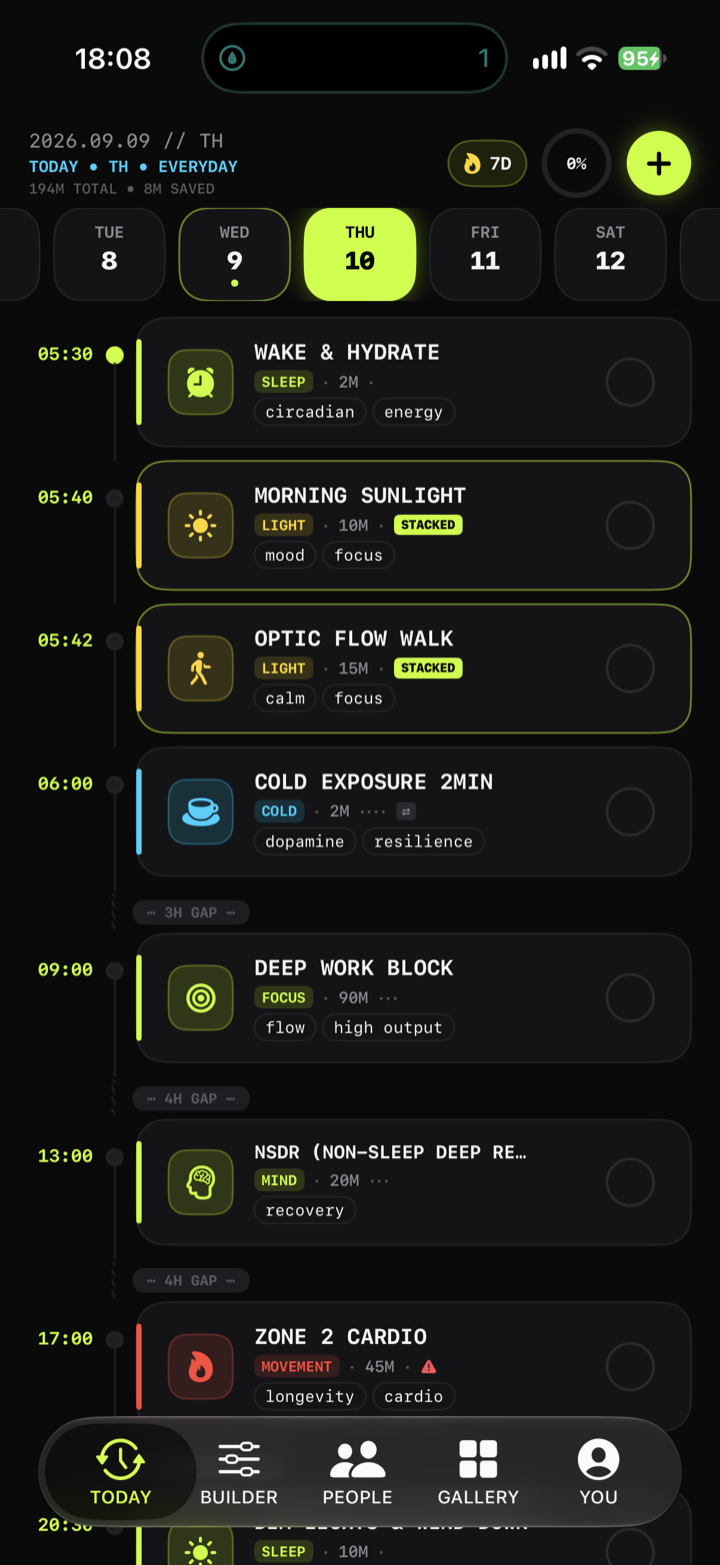

Short answer: Tim Ferriss’s morning routine is a ritual-anchored productivity stack: wake, make your bed, meditate ~20 minutes, do a 5-minute journal, and eat a slow-carb breakfast with stable glucose. The governing philosophy is Minimum Effective Dose (MED) — the smallest dose of an intervention that produces the desired result. In the Protocols app his blueprint is PROT_005 with 17 evidence-scored actions on his interactive leader page.
Why the Ferriss routine works
Tim Ferriss is the author of The 4-Hour Workweek and Tools of Titans and host of The Tim Ferriss Show. His morning framework is built on self-experimentation: he systematically tests habits on himself, keeps what survives, and discards what doesn’t. Two ideas carry the whole routine:
- Win the morning, win the day. The first hour sets your decision budget. Rituals remove choices (what to do, which order), which conserves willpower for deep work. In Protocols this is scored as decision-friction reduction — the same mechanism as habit stacking.
- Minimum Effective Dose. MED means finding the smallest change that gives the result, then doing exactly that — nothing more. Twenty minutes of meditation beats two hours of unfocused rumination; 5 minutes of journaling beats a 45-minute session you don’t keep up.
The whole routine costs roughly 45–60 minutes in the morning and is engineered to be repeatable at low effort — every action in the database rates 1–3 on the 1–5 effort scale. That’s intentional: Ferriss optimizes for consistency, because a routine you miss isn’t a routine.
The step-by-step morning protocol
References are action IDs from the Protocols database; durations and effort scores come from the app.
- Make your bed immediately (
ACT_046, 2 min, effort 1, evidence 3). A single completed task at 6:00 compounds into the first win of the day. Cheap, symbolic, effective. - Meditation — Transcendental or Vipassana (
ACT_047, 22 min, effort 2, evidence 5). Ferriss has publicly described a 20-minute twice-daily practice. Evidence for mindfulness-based meditation on attention and stress is the strongest of any habit in his stack. - Dead hang / spine decompression (
ACT_048, 2–5 min, effort 2, evidence 4). Spinal traction counteracts hours of sitting; also builds grip — a key longevity signal Attia’s program trains deliberately. - 5-minute journaling (
ACT_049, 5 min, effort 1, evidence 4). Gratitude, affirmations, and one daily focus. Cognitive reframing with a small time cost. - Morning pages — 3-page brain dump (
ACT_050, 15–20 min, effort 2, evidence 3). Julia Cameron’s classic: unfiltered writing that drains mental noise. Higher time cost; do only when morning pages beat the 5-minute journal for you. - Titanium tea ritual (
ACT_051, 5–8 min, effort 1, evidence 3). Green or yerba mate + cinnamon, his published morning beverage. Low effort, warm start. - Slow-carb breakfast: eggs & beans (
ACT_052, 15–20 min, effort 2, evidence 4). Protein-forward, low-glycaemic breakfast stabilizes glucose — measurable via continuous glucose monitor and relevant to afternoon energy. “Protein at breakfast” is one of the few nutrition habits with direct, well-replicated evidence for appetite control. - Phone in another room (
ACT_087, 90–180 min, effort 3, evidence 5). Ferriss writes extensively about removing the phone from the first hours of the day. Highest-evidence focus action in the stack — notification-free mornings measurably protect deep work. - 1 fear-facing outreach (
ACT_124, 15–20 min, effort 4, evidence 3). A deliberate uncomfortable task per day (the “fear-setting” practice from The 4-Hour Workweek). High effort by design — it’s the one action that trains discomfort tolerance.
Protocol snapshot
| Action | Time | Duration | Effort (1–5) | Cost (0–3) | Evidence (1–5) |
|---|---|---|---|---|---|
ACT_046 Make your bed | morning | 2 min | 1 | 0 | 3 |
ACT_047 Meditation (TM/Vipassana) | morning | 22 min | 2 | 0 | 5 |
ACT_048 Dead hang / spine decompr. | morning | 2–5 min | 2 | 1 | 4 |
ACT_049 5-minute journal | morning | 5 min | 1 | 1 | 4 |
ACT_050 Morning pages | morning | 15–20 min | 2 | 0 | 3 |
ACT_051 Titanium tea ritual | morning | 5–8 min | 1 | 1 | 3 |
ACT_052 Slow-carb breakfast | morning | 15–20 min | 2 | 1 | 4 |
ACT_087 Phone in another room | morning | 90–180 min | 3 | 0 | 5 |
ACT_124 Fear-facing outreach | morning | 15–20 min | 4 | 0 | 3 |
(PROT_005 — Tim Ferriss · 17 actions in database, morning block highlighted.)
Mistakes that break the routine
- Doing everything. MED means minimum effective dose — stack only what you’ll actually sustain. Three habits kept for a year beat nine abandoned in a month.
- Skipping the journal when busy. The journal is the anchor; if time collapses, keep meditation + journal and drop the rest.
- Morning pages after breakfast. The 3-page dump works best on an empty head; after email or coffee it turns into planning, not unloading.
- Treating meditation as optional. It’s the single highest-evidence action in the entire stack — skip tea, never skip it.
- Phone in the first hour. Every minute of phone = a decision stolen from your budget. If “another room” is impossible, put it in airplane mode.
How to start tomorrow
Pick three actions — that’s the Ferriss way:
ACT_046Make your bed (2 min, effort 1).ACT_04720-minute meditation (effort 2).ACT_052Slow-carb breakfast, no sugar (effort 2).
Run them for 14 days, then add ACT_049 journal and ACT_087 phone away. Add the titanium tea and fear-facing outreach only when the core five are automatic. This sequencing matches the app’s friction logic — build the low-effort base, then bolt on the high-effort ones.
Quick answers
Is the routine better than Huberman’s?
They’re different tools. Huberman’s is circadian-anchored (light, temperature); Ferriss’s is ritual-anchored (order, repeatability). The app’s Huberman protocol optimizes biology; Ferriss optimizes decision architecture — run them in the same morning if you want both.
How long until the routine sticks?
Consistency data from the app’s friction engine suggests ~2 weeks for low-effort stacks (effort ≤2) and ~4–6 weeks for stacks including effort-4 actions. Judge by completion streaks, not by day count.
Do I need the 20-minute meditation if I already train?
They serve different systems: training stresses physiology, meditation regulates arousal. If your meditation practice is already consistent, consider it a fixed part of the stack — it carries the strongest evidence of any habit here.
How to build this routine in Protocols
Open the Builder, add ACT_046 Make Your Bed, ACT_047 Meditation, and ACT_052 Slow-Carb Breakfast to your Everyday baseline. The friction engine will show the morning block at ~5 effort points — well inside the sustainable zone. Add ACT_087 Phone in Another Room for the focus layer. View the full 17-action blueprint on Ferriss’s leader page.
Sources & further reading
All claims in this article are grounded in the Protocols action database and the following primary sources:
- Tim Ferriss — official site
- Tools of Titans — Tim Ferriss
- PubMed — mindfulness meditation and psychological stress
Medical disclaimer: This article is for educational purposes only and does not constitute medical advice. The protocols described can stress the body and are not suitable for everyone. Consult a qualified physician before starting deliberate cold exposure, breath-hold training, fasting, or supplementation, especially if you have cardiovascular disease, high blood pressure, are pregnant, or take medication.