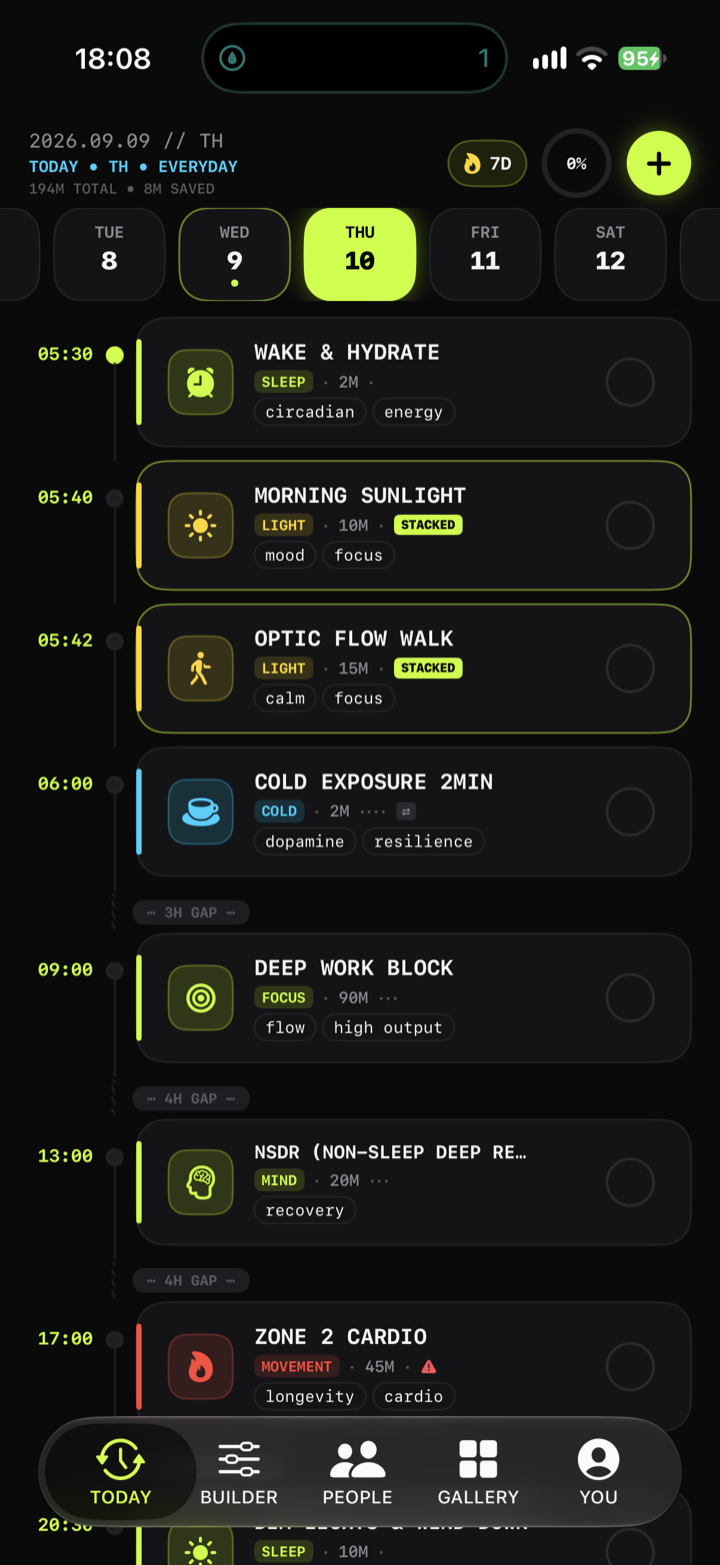

Short answer: The Huberman–Attia sleep protocol is an evidence-scored evening stack: caffeine cutoff by 14:00, dim lights from sunset, cool 18°C blackout bedroom, magnesium + glycine, optional mouth taping, and a post-dinner walk. It addresses sleep architecture (slow-wave + REM) rather than just “hours”. In Protocols it’s blueprint PROT_010 — the combined sleep architecture of Huberman and Attia — and most of its actions carry 4–5/5 evidence scores.
Why sleep architecture matters more than sleep hours
Huberman and Attia converge on the same point from different fields: it’s not how long you’re in bed, it’s what happens in the bed. Sleep architecture is the sequence of NREM (deep/slow-wave) and REM stages across the night.
- Deep (slow-wave) sleep drives immune clearance and morning energy; it dominates the first half of the night.
- REM sleep drives emotional processing and memory consolidation; it dominates the second half.
Damage the architecture and you get “8 hours of fragmented sleep” — wake at 3 AM, groggy mornings, and metabolic fog despite full pillow time. The evening stack below exists to protect architecture: anchor the circadian clock early (light), keep core temperature low (18°C), avoid arousal agents (caffeine, alcohol), and support neurotransmitter precursors (magnesium, glycine).
The step-by-step evening protocol
Action IDs, effort and evidence scores come from the Protocols database. This is a low-friction stack — almost everything is effort 1–2, because the goal is to remove decisions at night.
- Caffeine cutoff at 14:00 (
ACT_096, effort 2, evidence 5). Caffeine’s half-life is ~5–6 hours; a 2 PM coffee still occupies ~25% of receptors by 9 PM. In Huberman’s day the cutoff is the single highest-evidence sleep decision. - Dim lights after sunset (
ACT_013, 120–180 min, effort 2, evidence 5). Blue-rich overhead light suppresses melatonin. Use warm, low-intensity lamps from sunset; target <10 lux at the eye near bedtime. - Post-dinner walk 15 min (
ACT_120, 15–25 min, effort 1, evidence 5). Improves glucose disposal and shifts evening autonomic tone down. Also the “walk, don’t scroll” transition out of screen time. - Cool bedroom 18°C + blackout (
ACT_014, effort 1, evidence 5). Core body temperature must drop ~1°C to initiate sleep; 18°C room and blackout curtains support both temperature and melatonin. - Alcohol abstinence or minimum (
ACT_097, effort 3, evidence 5). Alcohol fragments REM and worsens sleep-disordered breathing. If you drink, stop 3 hours before bed and keep it light. - Magnesium + glycine stack (
ACT_083/ACT_037, effort 1, evidence 4). Magnesium supports GABAergic tone; glycine lowers core temperature and improves sleep quality in several trials. 30 min before bed. - Mouth taping (
ACT_095, optional, effort 2, evidence 4). Nose-breathing during sleep reduces snoring and mild apnoea events. Only with medical clearance if you have respiratory or cardiovascular conditions. - Consistent wake time (
ACT_015, effort 3, evidence 5). The anchor that makes evening bedtime possible — a fixed wake time daily locks the whole architecture.
Protocol snapshot
| Action | Time | Duration | Effort (1–5) | Cost (0–3) | Evidence (1–5) |
|---|---|---|---|---|---|
ACT_096 Caffeine cutoff 14:00 | afternoon | — | 2 | 0 | 5 |
ACT_013 Dim lights after sunset | evening | 120–180 min | 2 | 0 | 5 |
ACT_120 Post-dinner walk | evening | 15–25 min | 1 | 0 | 5 |
ACT_097 Alcohol abstinence/min | evening | — | 3 | 0 | 5 |
ACT_014 Cool bedroom 18°C + blackout | evening | — | 1 | 1 | 5 |
ACT_083 Magnesium complex | evening | 1 min | 1 | 1 | 4 |
ACT_037 Glycine + magnesium sleep stack | evening | 2 min | 1 | 1 | 4 |
ACT_095 Mouth taping (optional) | evening | — | 2 | 1 | 4 |
ACT_015 Consistent wake time | morning | — | 3 | 0 | 5 |
(PROT_010 — Huberman / Attia sleep architecture.)
Mistakes that destroy sleep architecture
- Evening caffeine “for the taste”. Decaf only after 14:00 — real coffee at 18:00 costs you deep sleep tonight.
- Bright bathroom lighting before bed. That single 500-lux LED step after your dim evening resets melatonin suppression. Switch to a warm nightlight in the bathroom.
- Exercising to exhaustion at 21:00. Late intense sessions raise core temperature exactly when it must drop. Finish heavy training 3+ hours before bed. (Attia’s deep-work day is morning-focused — see the decathlon protocol).
- Weekend “catch-up” sleep. A 5-hour shift between Friday and Saturday wake times is a mini-jet-lag every week. This is why
ACT_015exists. - Supplement-stacking everything at once. Start with magnesium alone for two weeks; add glycine, then try taping — otherwise you can’t tell what works.
How to start today
Sleep protocols reward sequence, not volume:
- Set
ACT_096— hard caffeine cutoff at 14:00 (biggest single win). - Set
ACT_014— 18°C and blackout (cheap, instant). ACT_120— 15-minute walk after dinner, no phone.
Week 2: add ACT_013 dim lights from sunset and ACT_083 magnesium. Week 3–4: mouth taping trial nights if you’re cleared. This is the fastest evidence-graded sleep stack in the library.
Quick answers
Is mouth taping safe?
For most healthy adults yes, but not for everyone — nasal blockage, sleep apnoea, or cardiopulmonary conditions require professional clearance first. Start with one side of the mouth.
What if I work night shifts?
Use the same stack on your “morning” (wake → dark bedroom immediately, blue blockers, caffeine cutoff shifted). Architecture matters more than clock position; the app’s timers can be anchored to your schedule.
Do I need a sleep tracker?
No. Track morning energy and wake-time consistency instead; consumer trackers overestimate sleep quality. If you suspect apnoea, see a clinician — no wearable replaces that.
How to build this protocol in Protocols
Open the Builder, add ACT_096 Caffeine Cutoff 14:00 and ACT_014 Cool Bedroom 18°C to your Everyday baseline, then ACT_120 Post-Dinner Walk and ACT_083 Magnesium to the evening block. The friction engine will keep the whole day well under overload — the sleep stack is specifically engineered to be low-effort. See the full sequence on Huberman’s leader page and Attia’s leader page.
Sources & further reading
All claims in this article are grounded in the Protocols action database and the following primary sources:
- Huberman Lab — sleep toolkit
- Peter Attia MD — The Drive podcast
- PubMed — glycine and sleep quality
- PubMed — bedroom temperature and sleep
Medical disclaimer: This article is for educational purposes only and does not constitute medical advice. The protocols described can stress the body and are not suitable for everyone. Consult a qualified physician before starting deliberate cold exposure, breath-hold training, fasting, or supplementation, especially if you have cardiovascular disease, high blood pressure, are pregnant, or take medication.