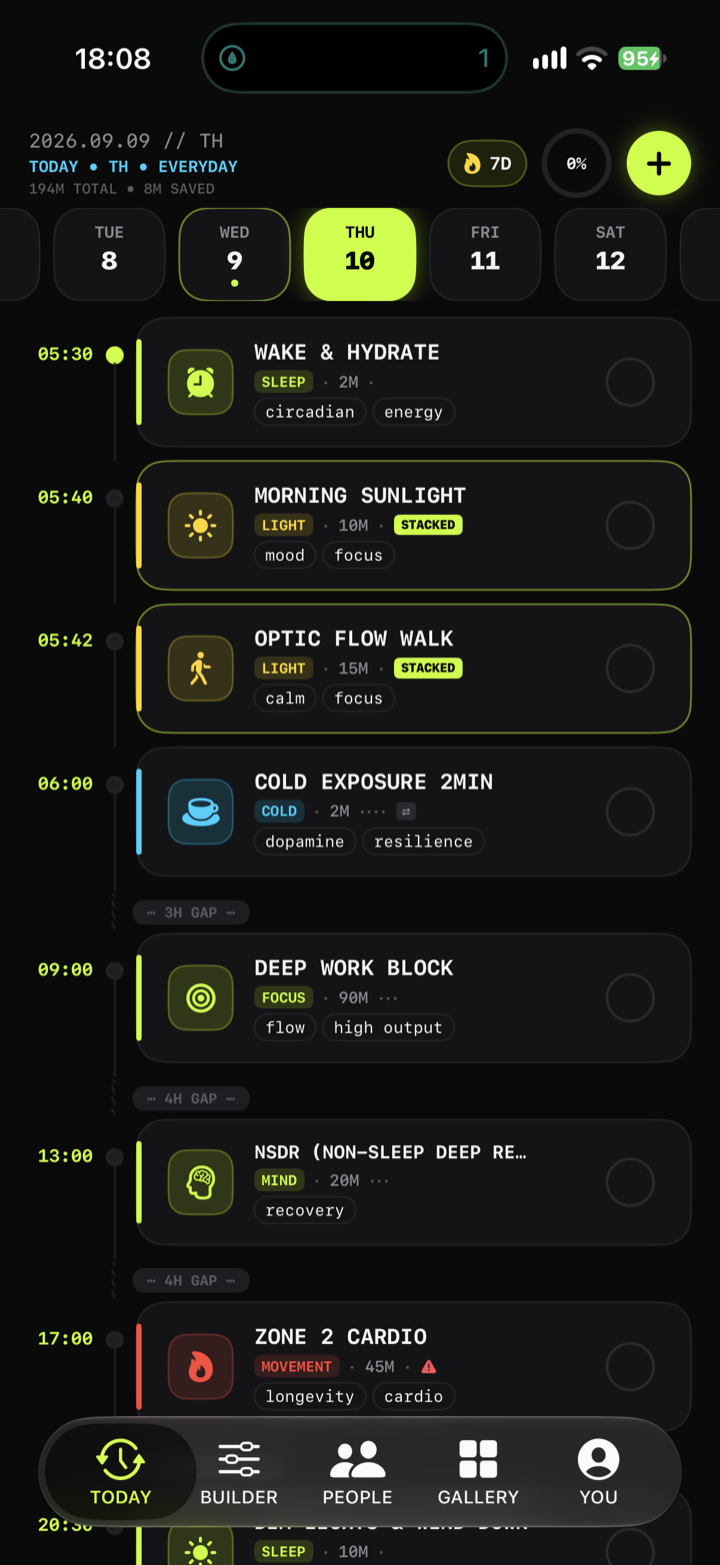

Short answer: David Goggins’s protocol is a high-friction discipline stack: wake at 4:00 AM with no snooze, stand at the accountability mirror, run 10–15 km in the morning, and push past the point where your brain says you’re done — the “40% rule”, which holds that when you feel completely spent, you’re at roughly 40% of real capacity. In Protocols it’s blueprint PROT_006, 9 actions on his leader page.
Why the 40% rule gets results (and why to be careful)
David Goggins is a retired Navy SEAL and ultra-endurance athlete — “the toughest man alive”. His book Can’t Hurt Me codified a framework that’s become central to productivity culture: the 40% rule, the accountability mirror, and the cookie jar (revisiting past wins when things get hard).
Two honest caveats before you adopt it:
- The science is weaker than the discipline. Goggins’s own life is the evidence — but in the Protocols database, his actions score low on scientific evidence (2–3/5) and extremely high on effort (4–5/5). This is a psychology protocol, not a physiology one; there’s limited peer-reviewed support for the specific 40% figure, and moderate support for the underlying idea that perceived effort underestimates real capacity.
- The protocol is a stressor, by design. 4 AM wake-ups at effort 5 in a cold bedroom, 10–15 km runs, and forcing past exhaustion are not suitable for everyone. A physician should clear anyone with cardiovascular history before adopting the run volume.
With those caveats, the framework is genuinely useful — because it trains the anterior mid-cingulate cortex (aMCC), the brain region associated with persistence. Effort expansions (doing hard things you don’t want to do) are one of the evidence-supported ways to build the “willpower muscle” — as long as the load is progressive and recoverable.
The step-by-step protocol
Action IDs and effort scores come from the Protocols database. Everything here is effort 3–5 — this is the opposite of a low-friction stack.
- Wake up 4:00 AM, no snooze (
ACT_053, 1 min, effort 5, evidence 2). The alarm setting is a test: snooze = negotiation with yourself before the day starts. Goggins treats the moment as binary — alarm rings, feet on floor. - Accountability mirror (
ACT_054, 5–10 min, effort 4, evidence 3). Stand and say the hard truths out loud — the “stay hard” conversation with yourself. A psychological anchor for what you’re avoiding. - Morning long run 10–15 km (
ACT_055, 60–90 min, effort 5, evidence 5). Goggins’s endurance base. Evidence for regular aerobic exercise is strong (effort 5 is his choice, not the evidence’s). Start far smaller if you’re new — see “how to start”. - Eat the frog — hardest first (
ACT_060, 30–60 min, effort 5, evidence 3). Do the most demanding task of the day before 9 AM, while willpower is freshest. This is the single most transferable habit in the stack. - The 40% rule threshold push (
ACT_058, 5–15 min, effort 5, evidence 3). When quitting feels inevitable, do one more controlled rep/sprint/minute. The goal is to extend the limit slightly, not to injure yourself. - The cookie jar reflection (
ACT_057, 3–5 min, effort 2, evidence 3). At a low moment, replay a past victory in detail. Psychological resourcing, evidence-adjacent to mental imagery and self-efficacy literature. - Deep mobility & stretching (
ACT_056, 45–60 min evening, effort 3, evidence 4). Goggins’s injury counterweight — he emphasizes structural work precisely because his training is extreme. Fix this before matching his reps. - Evening after-action report (
ACT_059, 5–10 min, effort 3). Write what went well and what you avoided. Closure + tomorrow’s plan.
Protocol snapshot
| Action | Time | Duration | Effort (1–5) | Cost (0–3) | Evidence (1–5) |
|---|---|---|---|---|---|
ACT_053 Wake 4:00 AM, no snooze | morning | 1 min | 5 | 0 | 2 |
ACT_054 Accountability mirror | morning | 5–10 min | 4 | 0 | 3 |
ACT_055 Morning long run 10–15 km | morning | 60–90 min | 5 | 1 | 5 |
ACT_060 Eat the frog / hardest first | morning | 30–60 min | 5 | 0 | 3 |
ACT_058 40% rule threshold push | anytime | 5–15 min | 5 | 0 | 3 |
ACT_057 Cookie jar reflection | anytime | 3–5 min | 2 | 0 | 3 |
ACT_056 Deep mobility & stretch | evening | 45–60 min | 3 | 0 | 4 |
ACT_059 Evening after-action report | evening | 5–10 min | 3 | 0 | 3 |
(PROT_006 — David Goggins · 9 actions in database.)
Mistakes that break the protocol
- Adopting 10–15 km runs as a beginner. Goggins’s volume requires years of base. Start with a 3–5 km fast walk/jog and progress 10% per week; volume is the highest-injury component.
- Zero rest days. An extreme stack without recovery isn’t discipline, it’s injury risk. Goggins’s own program includes deliberate mobility/recovery — keep at least 1 full recovery day.
- No medical clearance. Effort-5 + early waking + high run volume: cardiovascular screening first, period.
- Making the mirror negative. The accountability mirror is honest, not abusive; self-criticism without self-kindness collapses.
- Quitting the stack when life gets loud. Goggins warns precisely about this — the protocol is for maintenance, not only for crises.
How to start (the 40% you can sustain)
The point is expansion, not masochism. Start at ~40% of the dream protocol:
ACT_060Eat the frog — hardest task before 10 AM (effort 5, transferable).ACT_057Cookie jar — 3-minute victory recall at a low moment.ACT_003or a 20-minute walk/run instead of 10–15 km (see the morning sunlight article for the movement-stacking version).- Move wake time earlier in 15-minute weekly steps — not cold-turkey 4 AM.
Add the mirror and the report once these are stable. Full Goggins is a years-long ladder, not a day one.
Quick answers
Is the 40% rule proven?
The specific 40% figure is not a measured scientific constant — it’s a mnemonic. The general idea (perceived exertion underestimates capacity, and controlled effort expansion builds persistence) aligns with effort-training literature, but treat the number as motivation, not physiology.
Do I really need to wake at 4 AM?
No. Goggins’s wake time is a deliberate overload. The transferable principle is a consistent no-negotiation wake time — the circadian protocol achieves the same anchor with better evidence.
Doesn’t this burn you out?
Immediately after adopting Goggins’s full program? Often yes. The app’s friction engine rates a full Goggins day at 20+ effort points — above the sustainable ceiling. The formula that works is his principles at 40% load, recovered properly.
How to build this protocol in Protocols
Open the Builder and add ACT_060 Eat The Frog, ACT_057 Cookie Jar, and a movement action you’ll actually keep (ACT_055 scaled down). The friction engine will immediately flag the day as overloaded if you add ACT_053 wake 4:00 + ACT_055 10 km — that’s the tool helping you be honest. View the full 9-action blueprint on Goggins’s leader page.
Sources & further reading
All claims in this article are grounded in the Protocols action database and the following primary sources:
- David Goggins — official site
- Can’t Hurt Me — book page
- PubMed — physical effort and perceived exertion
Medical disclaimer: This article is for educational purposes only and does not constitute medical advice. The protocols described can stress the body and are not suitable for everyone. Consult a qualified physician before starting deliberate cold exposure, breath-hold training, fasting, or supplementation, especially if you have cardiovascular disease, high blood pressure, are pregnant, or take medication.