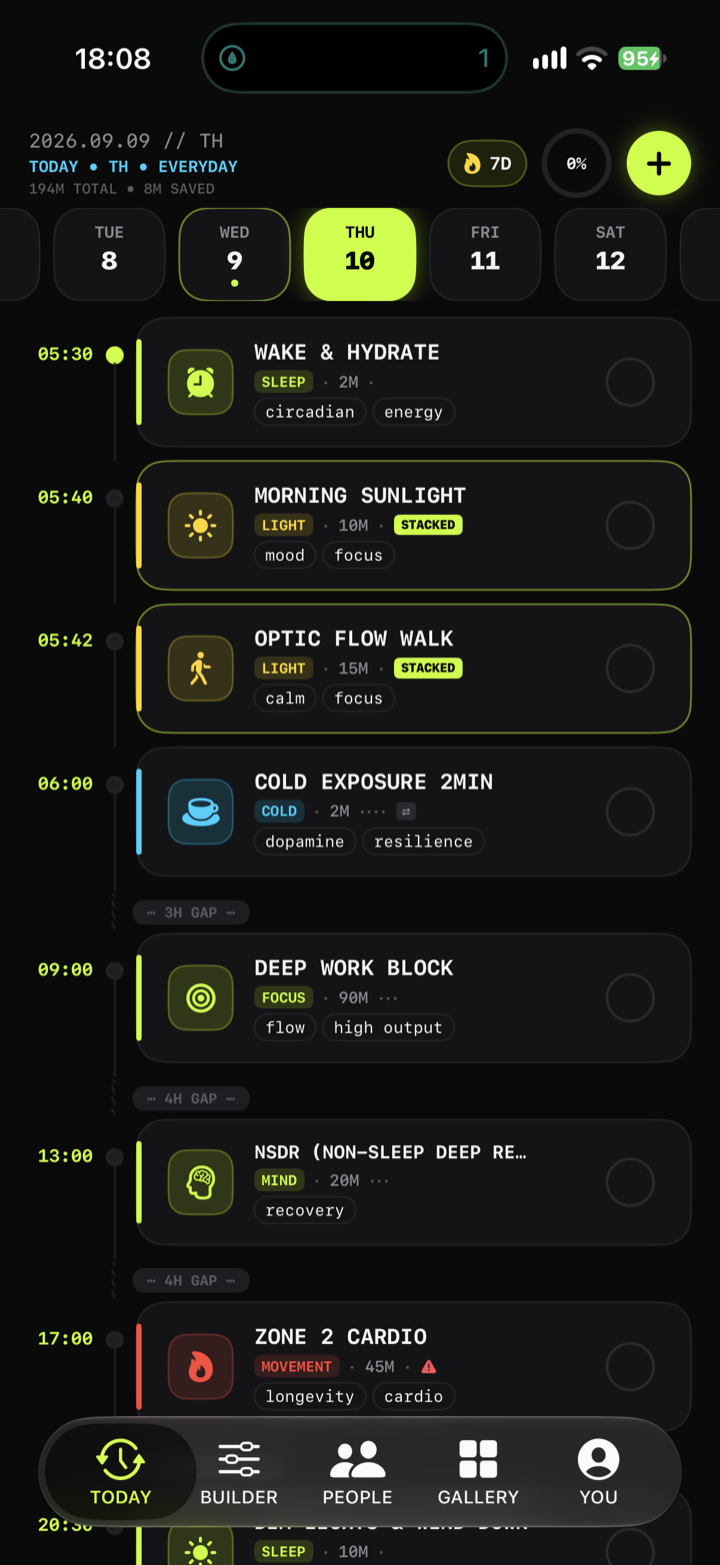

Short answer: Naval Ravikant’s daily routine is a low-dopamine framework: wake naturally by sunlight, meditate (“do nothing”) for up to 60 minutes, move slowly, avoid caffeine, sugar, alcohol, and news, and read deeply for an hour. His blueprint PROT_008 in Protocols scores 15 actions on his leader page — the counterweight to every go-faster productivity protocol.
Why the low-dopamine framework works
Naval Ravikant — co-founder of AngelList, essayist and podcast host — argues that sustained well-being comes from lowering stimulation, not raising throughput. His famous line: “A calm mind, a fit body, and a house full of love. These things cannot be bought. They must be earned.”
Three ideas underpin the routine:
- Happiness is a skill, not a state. He frames happiness as trainable — which means the practice matters more than the feeling. The 60-minute “do nothing” meditation is the daily gym for this skill.
- Dopamine is a battery, not a reward. Constant notifications, sugar, and news keep your baseline dopamine chronically elevated — so ordinary life (a walk, a meal) feels flat. Removing stimulation restores sensitivity. This maps to the app’s friction concept: he reduces sensory friction instead of adding willpower.
- Deep reading compounds. An unbroken hour of reading is (in his formulation) the highest-ROI activity for compound intellectual knowledge — reinforced by the Feynman principle: learn it, then explain it simply.
Evidence-wise, this routine scores better than Goggins’s on peer-reviewed support (4–5/5 on several actions): mindfulness meditation, circadian sleep, and news-reduction all have replication in the literature. The “zero caffeine” element is a personal choice with mixed individual evidence — some people genuinely prefer tea in the morning.
The step-by-step daily protocol
Action IDs, durations and effort scores come from the Protocols database.
- Natural awakening by sunlight (
ACT_062, 1 min morning, effort 2, evidence 4). He deliberately avoids waking to an alarm; the sun is the alarm. Same biology as the morning sunlight protocol — light anchors the circadian clock. - 60-minute “do nothing” meditation (
ACT_061, 60 min morning, effort 4, evidence 4). Sit, eyes mostly closed, no object of focus. He describes it as training the Default Mode Network to be quiet. Long-form meditation has consistent evidence for anxiety reduction; 60 minutes is his dose, not a requirement — 20 minutes already helps. - The happy body — slow movement (
ACT_063, 20–30 min morning, effort 2, evidence 4). Walking and body-weight movement done slowly, without strain. Recovery-friendly, unlike high-friction stacks. - Look up, smile & sunbathe (
ACT_064, 2–3 min now and then, effort 1, evidence 3). A micro-practice of presence — small, repeatable, almost zero cost. - Caffeine zero / decaf swap (
ACT_065, effort 4, evidence 4). Naval has discussed quitting caffeine entirely. Mixed individual evidence; if you swap, do it gradually (see caffeine delay in the Huberman protocol). - Sugar, alcohol & social detox (
ACT_066, effort 4, evidence 5). Alcohol and excessive sugar have strong evidence against them; the social element is his specific choice (cutting noisy social media circles). - No news / zero outrage media (
ACT_117, effort 3, evidence 4). The 24-hour news cycle activates threat circuits (the “outrage cycle”); removal measurably lowers anxiety in studies of news consumption. - Deep book reading 60 min (
ACT_070, 45–60 min afternoon, effort 2, evidence 4). Long-form reading without the phone nearby. - No-meetings focus day (
ACT_089, effort 2, evidence 4). A full day protected from scheduled interaction — deep work at the weekly scale. - One deep meaningful conversation (
ACT_115, 20–30 min evening, effort 2, evidence 5). He names a real conversation as a cornerstone daily practice — strong evidence for social connection and loneliness reduction. - Loving-kindness (metta) 10 min (
ACT_126, evening, effort 2, evidence 4). Contemplative closing with documented mood benefits.
Protocol snapshot
| Action | Time | Duration | Effort (1–5) | Cost (0–3) | Evidence (1–5) |
|---|---|---|---|---|---|
ACT_062 Natural awakening by sunlight | morning | 1 min | 2 | 0 | 4 |
ACT_061 “Do nothing” meditation | morning | 60 min | 4 | 0 | 4 |
ACT_063 Happy body slow movement | morning | 20–30 min | 2 | 0 | 4 |
ACT_064 Look up, smile & sunbathe | anytime | 2–3 min | 1 | 0 | 3 |
ACT_065 Caffeine zero / decaf | anytime | — | 4 | 0 | 4 |
ACT_066 Sugar, alcohol & social detox | anytime | — | 4 | 0 | 5 |
ACT_117 No news / outrage media | anytime | — | 3 | 0 | 4 |
ACT_070 Deep book reading 60 min | afternoon | 45–60 min | 2 | 0 | 4 |
ACT_089 No-meetings focus day | anytime | 8 h | 2 | 0 | 4 |
ACT_115 One deep conversation | evening | 20–30 min | 2 | 0 | 5 |
ACT_126 Loving-kindness 10 min | evening | 10 min | 2 | 0 | 4 |
(PROT_008 — Naval Ravikant · 15 actions in database, main day highlighted.)
Mistakes that break the low-dopamine protocol
- Cold-turkey caffeine + news + sugar on day one. Triple withdrawal within a week; do one at a time over 2–4 weeks.
- Skipping the meditation when you “don’t have time”. This routine’s value is the meditation — it’s the reason to reduce everything else.
- Reading with the phone nearby. Deep reading requires the same phone discipline as deep work; otherwise it’s skimming.
- Treating “no meetings” as laziness. A no-meetings day is a protected asset — schedule it in advance, don’t leave it to chance.
- Judging 60 minutes as a failure if you need 20. The dose is his; the evidence doesn’t require an hour.
How to start today
Go in the order of evidence:
ACT_117Put the phone news apps away for 3 days (effort 3, evidence 4).ACT_06110 minutes of “do nothing” meditation — no app, no timer anxiety (effort 2 scaled down).ACT_07030 minutes of a physical book, phone in another room.
Add sun-based waking and one deep conversation per day in week 2. This is the gentlest routine in the entire Protocols library precisely because it’s a withdrawal protocol, not a load protocol.
Quick answers
Is “do nothing” meditation real meditation?
It’s a recognized contemplative practice (open awareness / choiceless awareness). It differs from concentrative meditation but is well-documented; the key is being awake and without object, not relaxed-sleeping.
Why does Naval reject caffeine but use tea?
He has described both a zero-caffeine phase and dissent on tea. Treat it as individual experimentation, not a universal — what matters is eliminating afternoon crashes and sleep-time arousal.
Is this compatible with a busy workday?
The no-meetings day is the hard part. Practically: deep-read over lunch, one meditation block at 7 AM, one genuine conversation at dinner. That’s the “minimum effective dose” version of Naval.
How to build this routine in Protocols
Open the Builder, add ACT_061 Do-Nothing Meditation to your morning and ACT_070 Deep Book Reading to your afternoon, then ACT_115 One Deep Conversation to the evening. The friction engine will report a day under 10 effort points — the lowest of any leader blueprint — which is exactly the point. Full 15-action version on Naval’s leader page.
Sources & further reading
All claims in this article are grounded in the Protocols action database and the following primary sources:
Medical disclaimer: This article is for educational purposes only and does not constitute medical advice. The protocols described can stress the body and are not suitable for everyone. Consult a qualified physician before starting deliberate cold exposure, breath-hold training, fasting, or supplementation, especially if you have cardiovascular disease, high blood pressure, are pregnant, or take medication.